- Home
- Aerospace turbine repair
Turbine blade and vane repair engineering
Since 2021 we have developed precision, robotic, near-net repair processes for turbine blades and vanes with local aerospace companies, and developed specialised tooling for a range of aerospace products. Our near-net surface build-up process is patent pending.
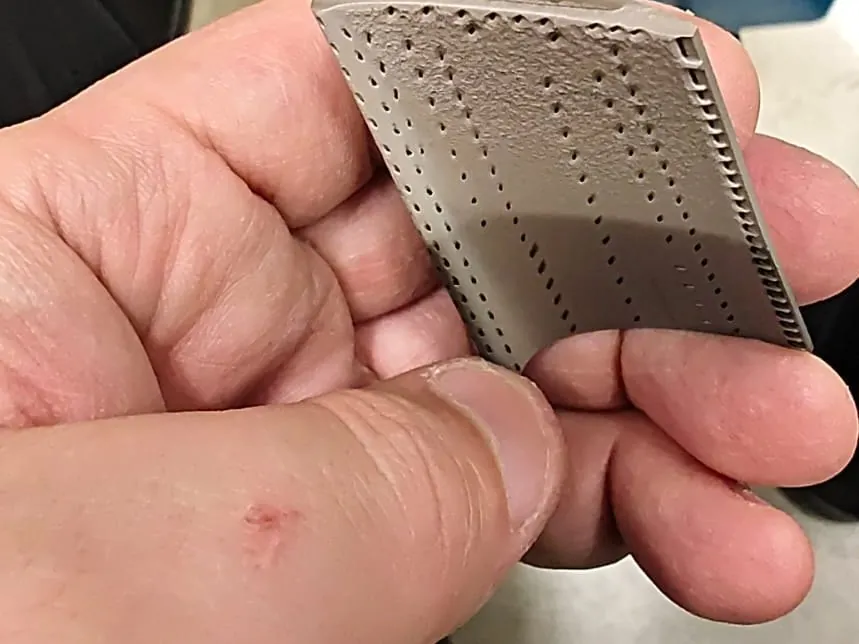
Turbine repair that keeps more of the part.
High-pressure turbine blades and vanes come back from service distorted, eroded and cracked. The usual fix is braze paste, a furnace cycle and hours of hand blending, which removes base metal and clogs cooling holes.
Our near-net surface build-up sprays braze alloy, base-metal powder or a mix of both only where the part needs it, in thin, uniform layers that follow the original contour. The standard heat treatment stays the same. What changes is how little blending is left afterwards.
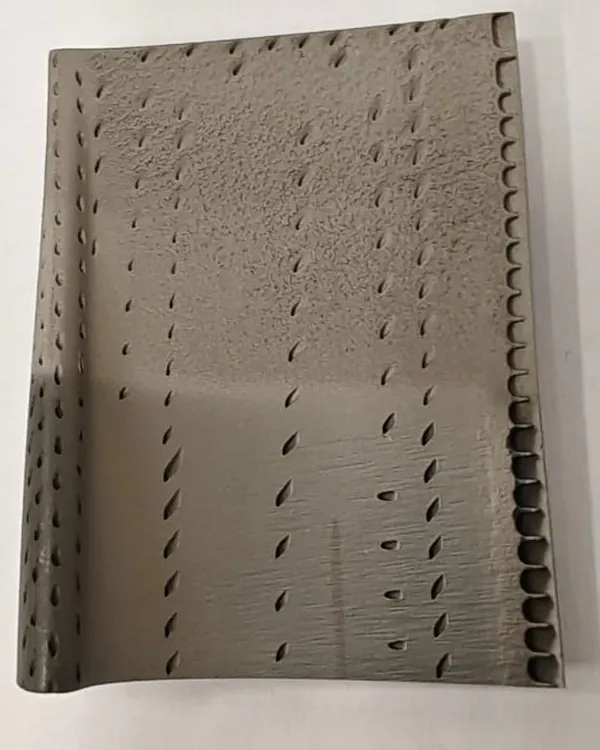
As applied: a 40 μm layer on a turbine airfoil, with every cooling hole left open.
Results from Metcon trials on coupons and MRO parts. Every customer process is validated separately.
From worn part to finished surface
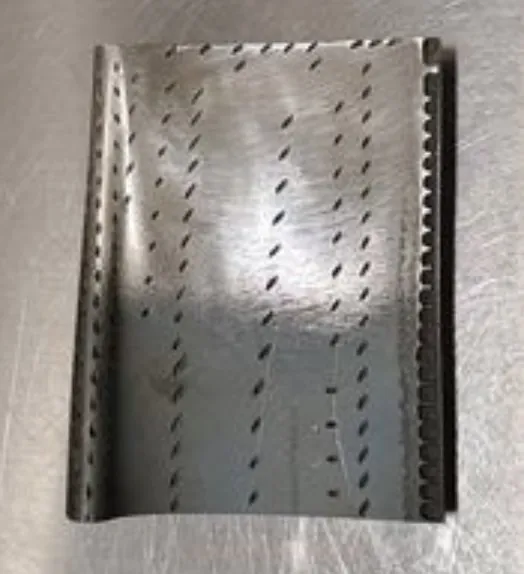
One of our airfoil trials, photographed at each stage. Patent pending.
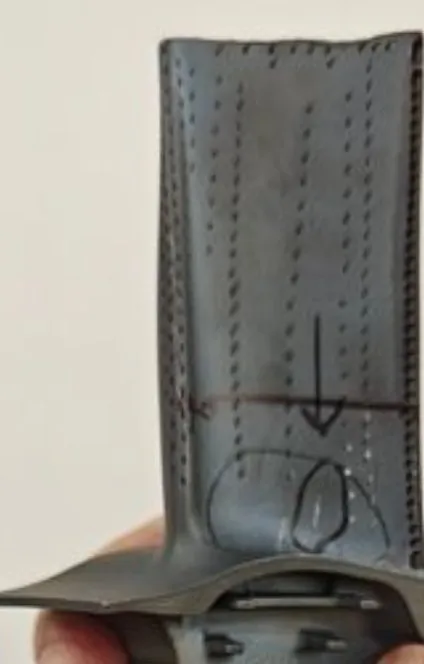 As receivedService-worn airfoil with the repair area marked.
 Cut and cleanedSection cut and abrasive cleaned to bare metal.
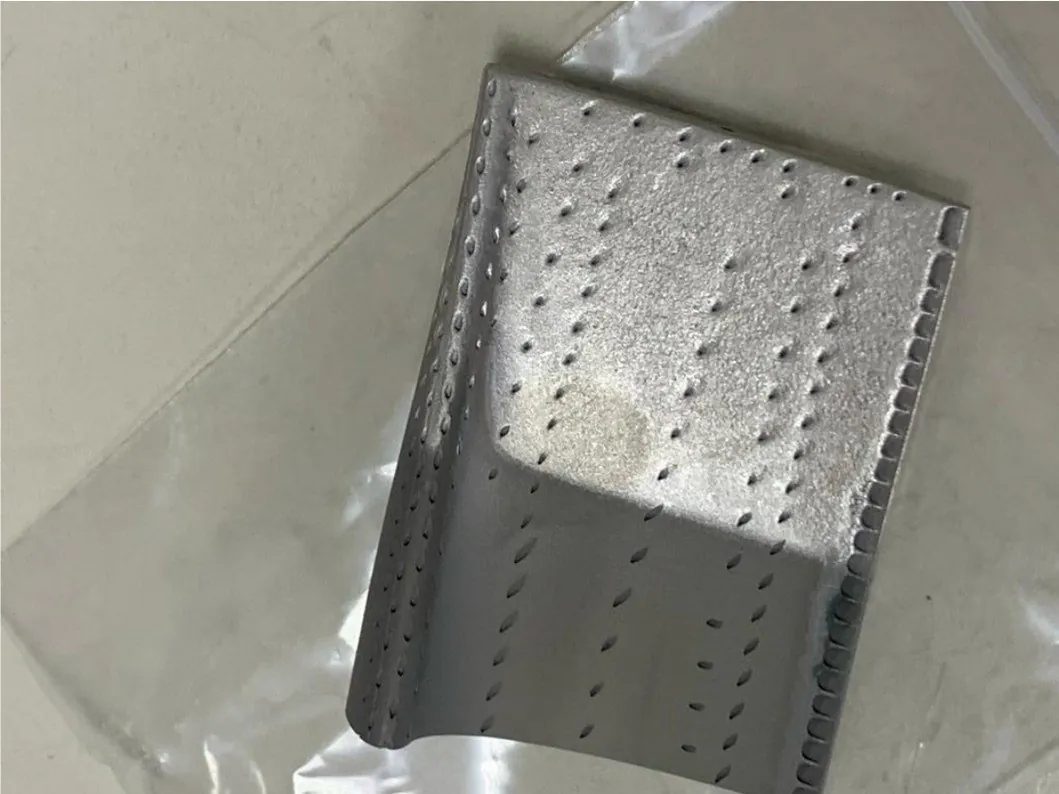 Braze appliedMixed alloy sprayed only where needed. Cooling holes stay open.
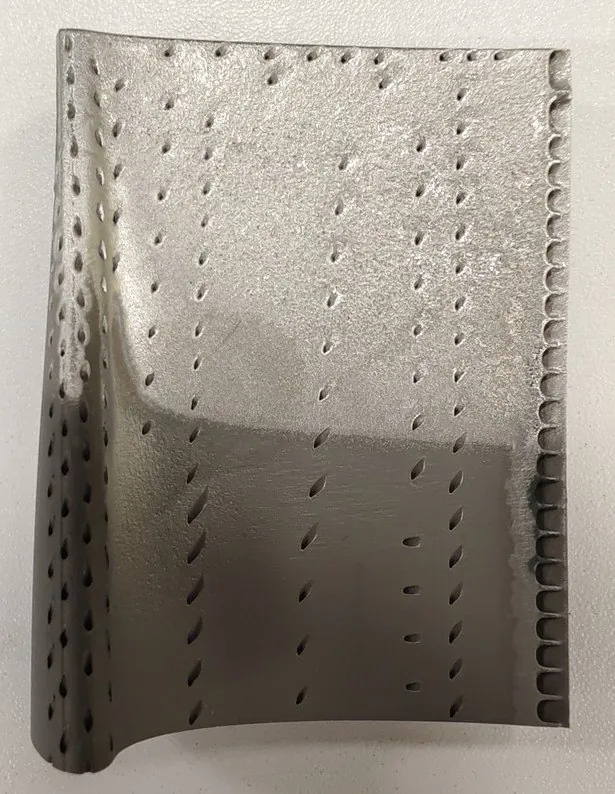 After melt cycleStandard furnace cycle. Near-net surface, minimal blending left.
Present brazing
- Two alloy powders mixed with an organic binder
- Paste applied to the part by hand
- Binder dried off
- Heat treatment
- Manual or robotic blending of excess braze
- Cooling holes re-drilled
Metcon near-net build-up
- Two alloy powders mixed dry
- Robotic spray, only where the part needs it
- No binder to dry
- Same heat treatment
- Minimal blending
- Cooling holes left open
- Materials trialled
- Braze powders NB 200 and AMS 4777, base alloy powder Inconel 718, on Inconel 625 substrate
- Distortion tolerance
- Distorted vanes can be built up as long as distortion stays within 2 mm
- Metal to the milligram
- A typical 12 mm crack, 0.127 mm wide and 0.508 mm deep, needs 0.774 mm³: about 0.0062 g of metal
- Post processing
- Standard furnace route, with optional local laser post-processing
Our approach
| Part | Repair | Usual method | Our approach |
|---|---|---|---|
| HPT blades | Tip weld repair | Manual or semi-automatic welding | Laser cladding with specialised powders, low heat input |
| HPT blades | Blending after tip weld | Manual | Robotic scanning to a best-fit form, then robotic blending |
| HPT blades | Tip composite plating | None | Composite plating for erosion resistance |
| Turbine vanes | Braze repair | Manual paste application | Robotic spray application with less overhang |
| Turbine vanes | Blending brazed areas | Manual, with small tools | Robotic blending with tools checked for reach |
| Turbine vanes | Cooling holes after braze | Re-drill by EDM or laser | Braze that leaves holes open, then laser reaming |
| LPT blades | Tip knife-edge repair | Manual | Laser cladding of the knife edge |
| Compressor blades | Surface finishing | Hand polishing | Mixed-media vibratory finishing; spark-safe methods for titanium |
| Blades and vanes | Inspection | Visual or aided visual | Thermography imaging that quantifies defects |
How we work with repair shops
- AssessReview the part, its condition and your current route.
- TestRun controlled trials with the right powder and settings.
- OptimiseTune thickness, location and process parameters.
- ValidateCheck post-processing, profile and part condition.
- DeployRun it for you, license it, or set it up in your shop.
Automated blending cells
For OEM and MRO blades and vanes, we design blending cells around a collaborative robot. A blue-light scanner measures the part to within 100 microns, software converts the scan to CAD and robot paths, and the robot blends to a best-fit form with compensation applied.
See how we design a blending cell
Ways to work with us
- We apply the repair for you
- Technology testing and process optimisation
- Licensing
- Joint development
- Working inside your operation
- Client-led testing and qualification
What we need to scope a repair or a cell
- The part, or pictures of it, and the area to repair
- The stage in the turbine and your current repair method
- Pre-process before blending and the finish you need
- Final dimensions as a CAD file or a master part
- Volume, turnaround time and precision expected
- Shop floor space available and your timeline
Frequently asked questions
Not covered here? Call +65 9060 0775 or send us the details.
Does near-net build-up fill the cooling holes?
No. In our airfoil trials a 40 µm layer was applied with every cooling hole left open, so the holes do not need re-drilling.
Does it change our heat treatment?
No. The standard furnace route stays the same. Local laser post-processing is available where it helps.
Which alloys have you trialled?
Braze powders NB 200 and AMS 4777 and base alloy powder Inconel 718, on an Inconel 625 substrate, alone or mixed.
Can distorted vanes be repaired?
Yes, as long as the distortion is within 2 mm. The application tolerance follows the part.
Is the process protected?
Our near-net surface build-up process is patent pending.
How can we work together?
We can apply the repair for you, test and optimise it with you, license it, develop it jointly or work inside your operation.
Send us the part and the area to repair. We will scope the process.
Call +65 9060 0775 or email metcondndt@gmail.com